

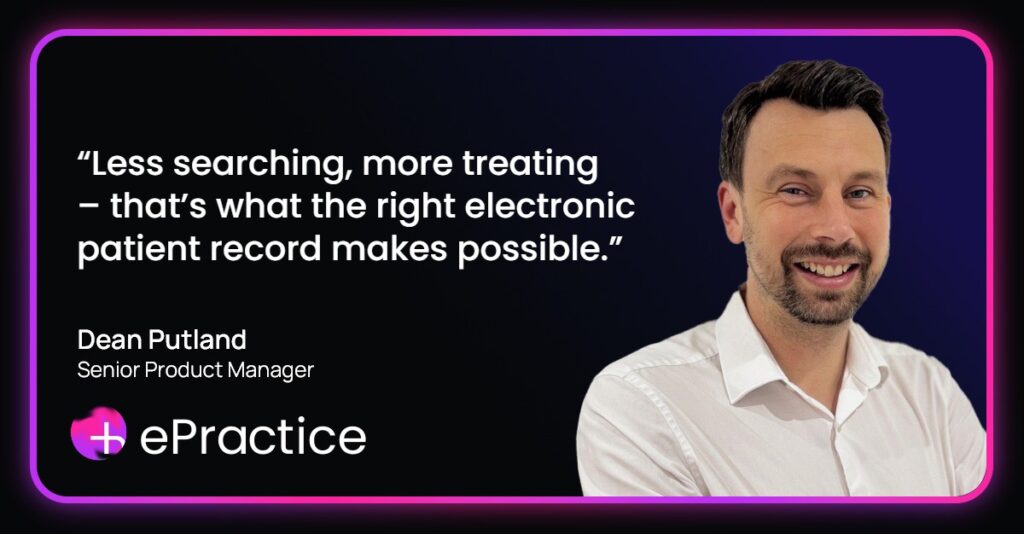
Dean Putland, Senior Product Manager
Your patient records might be slowing you down more than you think. Not because they’re incomplete but because they’re scattered across systems, spreadsheets, notes and inboxes. Easy enough to store, but not always easy to bring together when you actually need them.
In a busy private medical practice, that starts to add up quickly. Research shows some practitioners spend four times longer on admin than with patients1. That’s not just system inefficiency – it’s time taken away from care. And in a busy practice, that time disappears quickly.
So where do electronic patient records (EPR) fit into all of this?
In simple terms, an EPR is the digital record your practice uses day to day – bringing together clinical notes, patient information and workflows in one place.
But more importantly, it’s about how that information is used. Because when everything from allergies to ePrescriptions sits in one connected system – instead of being spread across different tools and formats – you spend less time searching and more time using the information in front of you.
And that’s where the real shift happens.
Why patient records still eat so much time in private practice
For most private medical practices, it’s not one big issue – it’s lots of smaller ones working together:
- Multiple systems that don’t quite connect
- Duplicate patient records and inconsistent data
- Notes stored in different formats and locations
- Tasks and follow-ups tracked manually
None of this feels dramatic in isolation. But over the course of a day, it adds up.
You switch between systems. You re-enter information. You double check things you shouldn’t have to. And before you know it, managing records has become a significant part of the working day.
The hidden impact on patient care and decision-making
This isn’t just about efficiency – it’s about what happens as a result. When patient information is harder to access or incomplete:
- consultations take longer
- decisions feel less confident
- follow-ups become harder to manage
- care becomes more fragmented
When information flows, care flows. But when it doesn’t, everything feels slightly harder than it should.

How EPR systems speed things up
A good EPR isn’t just about digitising records. It’s about making them work for you. That means:
- Keeping patient information in one place
- Structuring notes so they’re consistent and easy to use
- Supporting workflows with clear tasks, alerts and communication
- Making information accessible exactly when you need it
The difference isn’t just “paper vs digital”. It’s the difference between searching for information and being able to act on it instantly. I sum it up as – less searching and more treating.
How private medical practice management software supports better patient records
Smart software doesn’t just store patient records – it connects them to everything else happening in your practice.
Appointments, clinical notes, tasks, invoicing and reporting all sit within one system, removing the need to switch between tools or duplicate information. Instead of disconnected processes, you get a joined-up workflow where everything supports everything else.
And that’s where you start to save serious time. ort. It’s how well communication fits into real life and how easy it is for patients to act on it when it matters.
5 things to look for in EPR software for private healthcare
If you’re reviewing your current setup, or exploring something new, a few things make a real difference:
- Ease of use – if it’s not simple, it won’t get used properly
- Data accuracy – duplicate checks and structured inputs keep records clean and reliable
- Workflow support – good systems help you manage tasks and follow-ups – not just store information
- Security and compliance – patient data needs to be handled securely, with the right protections in place
- Integration across your practice – the biggest gains come when everything connects, not when systems work in silos.
How ePractice brings everything together
This is exactly what ePractice electronic patient records are designed to solve.
When patient information sits across multiple systems, it creates friction – in your workflow, your decision-making and the overall patient experience. ePractice removes that by bringing everything into one place.
As part of a complete private medical practice management software platform, ePractice links your records to everything else happening in your practice – from appointments through to invoicing – so nothing gets missed and everything works together.
The result?
- Clear, consistent records
- More confident decisions in the moment
- Less admin and fewer interruptions
- A smoother, more joined-up patient experience
See ePractice in action
Built on 25+ years of healthcare technology expertise and powered by Healthcode Intelligence (Hi), ePractice cuts out the friction – less switching, less admin and fewer gaps – so you can be the best you can be.
Book a 30-minute demo and see how ePractice helps you stay on top of patient records, reduce admin and keep your practice running smoothly.
Sources
1. QJM International Journal of Medicine, 2025: https://academic.oup.com/qjmed/article/118/10/753/8171816