
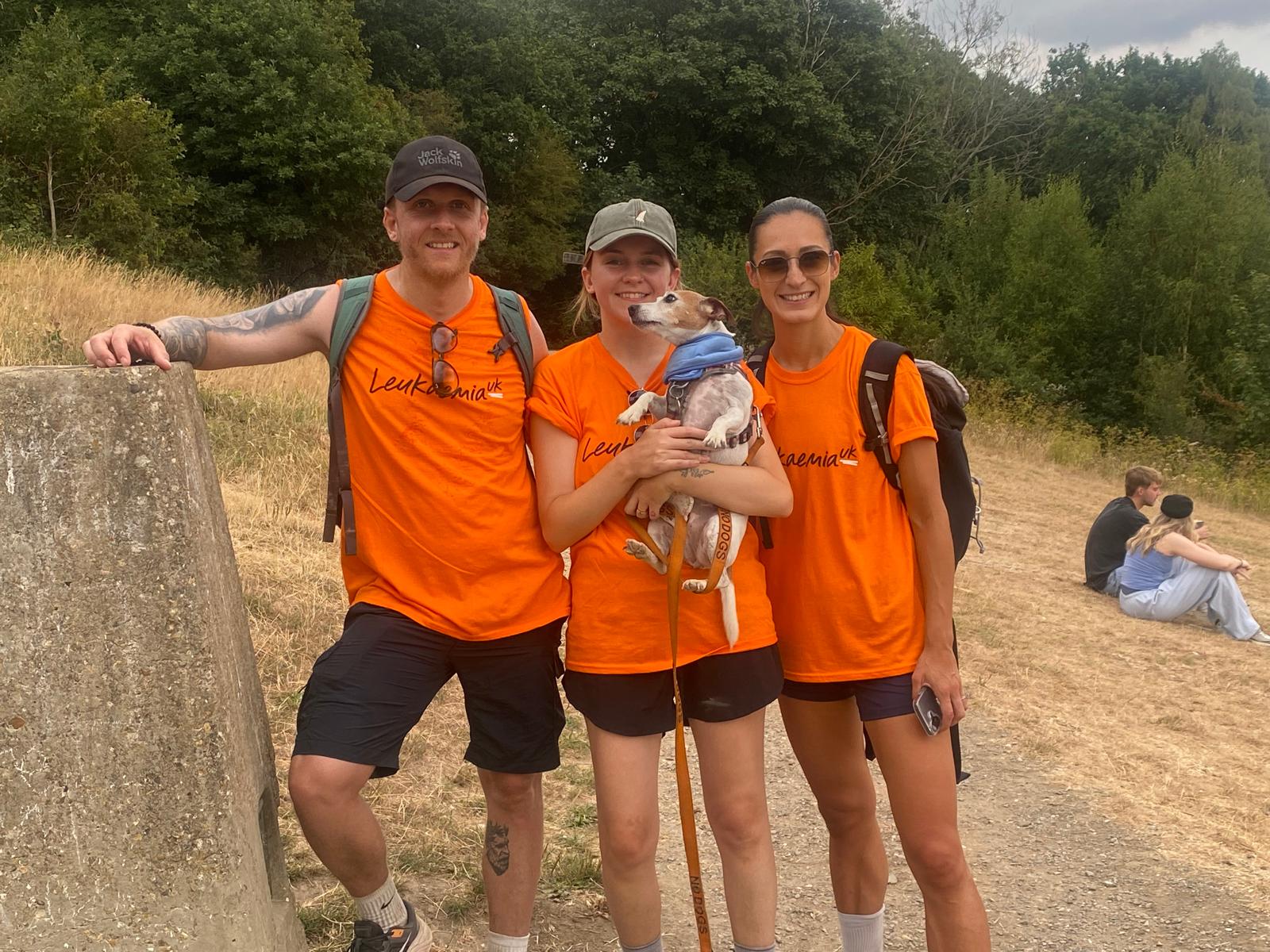
To mark Blood Cancer Awareness Month, Sam shares his story and explains why it meant so much to conquer the Surrey Three Peaks Challenge for Leukaemia UK.
It’s a 37 km circular hike which includes three big climbs totalling over 1,000metres. I teamed up with my wife and sister-in-law and our route took us in a big loop, taking in ascents to the summits of Leith Hill, Holmbury Hill and Box Hill before dropping right back down to the bottom each time. I didn’t expect the climbs to be that steep and the August heat made the challenge even tougher.
How did it feel when you crossed ‘the finishing line’?
I was completely knackered as we’d started at 7am and it was on the verge of getting dark when we finished about 11 hours later. By that point, my overriding feeling was relief.
It was when we all went to the pub and had the chance to look back on the experience together that I felt a sense of accomplishment. It was incredible to think that six months ago I could barely walk up and down stairs after going through my own treatment for Leukaemia and I’m still dealing with some physical effects.
Originally, I was going to leave the challenge to my wife and sister-in-law but I wanted to do it because we could raise more money for Leukaemia UK. I also thought it would be good for me as I’ve always been a very active person. Taking on the challenge was another part of my recovery – both physical and mental – to build up my fitness and prove to myself that I could still get out there.
How much has this challenge raised for Leukaemia UK and how will it help the charity’s work
We raised £2,675 on the day but Healthcode will match that, so the total is currently £5,350. That money will fund research into new treatments and drugs for Leukaemia which will hopefully improve patient care and treatment outcomes. Leukaemia UK is a relatively small blood cancer charity which means every penny raised really counts.
Having been through Leukaemia treatment yourself makes your achievement even more impressive. Can you share your story?
My diagnosis came out of the blue and completely by chance.
It all started when I sustained concussion during a football match and started getting severe headaches. The doctors found I had an old bleed on the brain which required surgery.
I thought I’d recovered enough to play football but I started feeling unwell again so I went to A&E. The scan of my head was clear but the doctors thought one of my blood results looked strange so they admitted me. The next day they told me that my platelet levels were abnormally low and I was diagnosed with Acute Myeloid Leukaemia (AML) which is an aggressive cancer that attacks white blood cells.
At that point I hadn’t had started to show any of the usual symptoms like fatigue, shortness of breath, infections, bruising or nosebleeds. I was just getting on with my life and preparing to get married so it came as a total shock.
If it wasn’t for the fact that I’d had a headache after playing football and ended up in A&E, I wouldn’t have been diagnosed until my blood count had fallen very low and I’d became seriously ill. It was only through a bizarre set of circumstances that they caught it so early and I could start treatment when I was relatively well.
What was your treatment journey like?
AML needs urgent treatment. I had a platelet transfusion to restore the level in my blood and the doctors did a bone marrow biopsy which meant they could look for genetic mutations and other markers that would show the likely course of the disease and treatment options.
It turned out I had a genetic marker associated with high-risk AML so I was told early on that I’d need a bone marrow transplant as well as chemotherapy and they started looking for the best possible match both within my family and on the global register. We were told a sibling donor was the best chance, reducing the possibility of complications like graft versus host disease but the odds were still only 25%. I was incredibly lucky that my only brother Alex turned out to be a good match. That also meant they could carry out the transplant on the same day in the same hospital, rather than transfer the donation over a long distance.
Before I could have the transplant, I had to have three rounds of chemotherapy to destroy all my white blood cells – good and bad – which involved three stays in isolation in hospital as it wiped out my immune system each time.
When I was ready for the bone marrow transplant, I had to have something called conditioning therapy which was a high dose of chemotherapy drugs and total body irradiation to destroy any remaining cancer cells and supress my immune system to prevent rejection. They used an incredibly clever machine to harvest the stem cells from my brother’s blood over five hours and then recirculate it to his body. Then they brought the donation upstairs to me in a little pink bag and it was infused into my arm in about 15 minutes. They monitored me for about half an hour but then it’s a case of allowing the stem cells to go to work.
We knew the treatment was starting to take effect after a couple of weeks because I began feeling quite intense pain in my lower back which is where you find most of your bone marrow.
When did you start feeling better?
I was discharged from the hospital in December and it was lovely to be home for Christmas.
After that, I attended a clinic every Monday for a check-up. One issue was that my brother and I were completely different blood groups so there was a transition period when my body was fighting the new blood cells and my haemoglobin levels dropped. That meant I had to have a transfusion every couple of weeks for about six months until my own blood group changed. I’m now officially A Negative!
By February, I still couldn’t walk far but I was bored of sitting at home doing nothing so I decided to go back to work at Healthcode. I started doing a couple of hours here and there to get back up to speed and start feeling part of things again and then built up gradually. My goal is to be back to five days a week by the end of this year although it will mostly be working from home as my immune system has been compromised.
Getting back to work has been important for my mental health and it’s been good for my family to see me up and about again. We’ve also been planning our wedding which took place in early September. My wife and I officially got married at a quiet ceremony in January but this was a chance to celebrate properly.
What does Healthcode’s Charitable Partnership with Leukaemia UK mean to you?
Healthcode has supported me throughout my illness and I know that wouldn’t happen in every company. I was especially touched by the Charitable Partnership with Leukaemia UK because the decision was put to a vote and backed by my colleagues.
There are loads of different fundraising activities taking place, from bake and plant sales to a fantasy football league and sponsored challenges like the Surrey Three Peaks or the Vitality 10K. At our last Company Day we had a charity stand and raffle and our partners and customers got involved too.
Awareness raising is almost as important as raising money – what would you like people to know about Leukaemia and what one thing could they do to help?
The number one thing I’d like people to know about is the Stem Cell Register. I was lucky to have a sibling match but that isn’t the case for a lot of people out there so we need a wide pool of potential donors so they have the same chance.
Secondly, please consider donating blood as I wouldn’t be here without those transfusions and they are vital in the treatment of other bone marrow diseases and cancers.
Finally, it would be great if you could consider Leukaemia UK if you are donating to charity. This is an exciting time for Leukaemia research with amazing breakthroughs being made all the time. We know so much more about things like genetic factors and blood markers compared with a few years ago and that will go a long way to improving our understanding of Leukaemia and the best way to tackle it. I’ve certainly seen that for myself during the last year.